A cell phone booster catches the weak signal outside your home, makes it stronger and rebroadcasts it indoors, where your phone can use it. The same path runs in reverse when you talk or send data. That, in one breath, is how a cell phone booster works. The rest belongs to the owner: FCC conditions that apply before the booster runs, and a roof or wall someone has to drill.
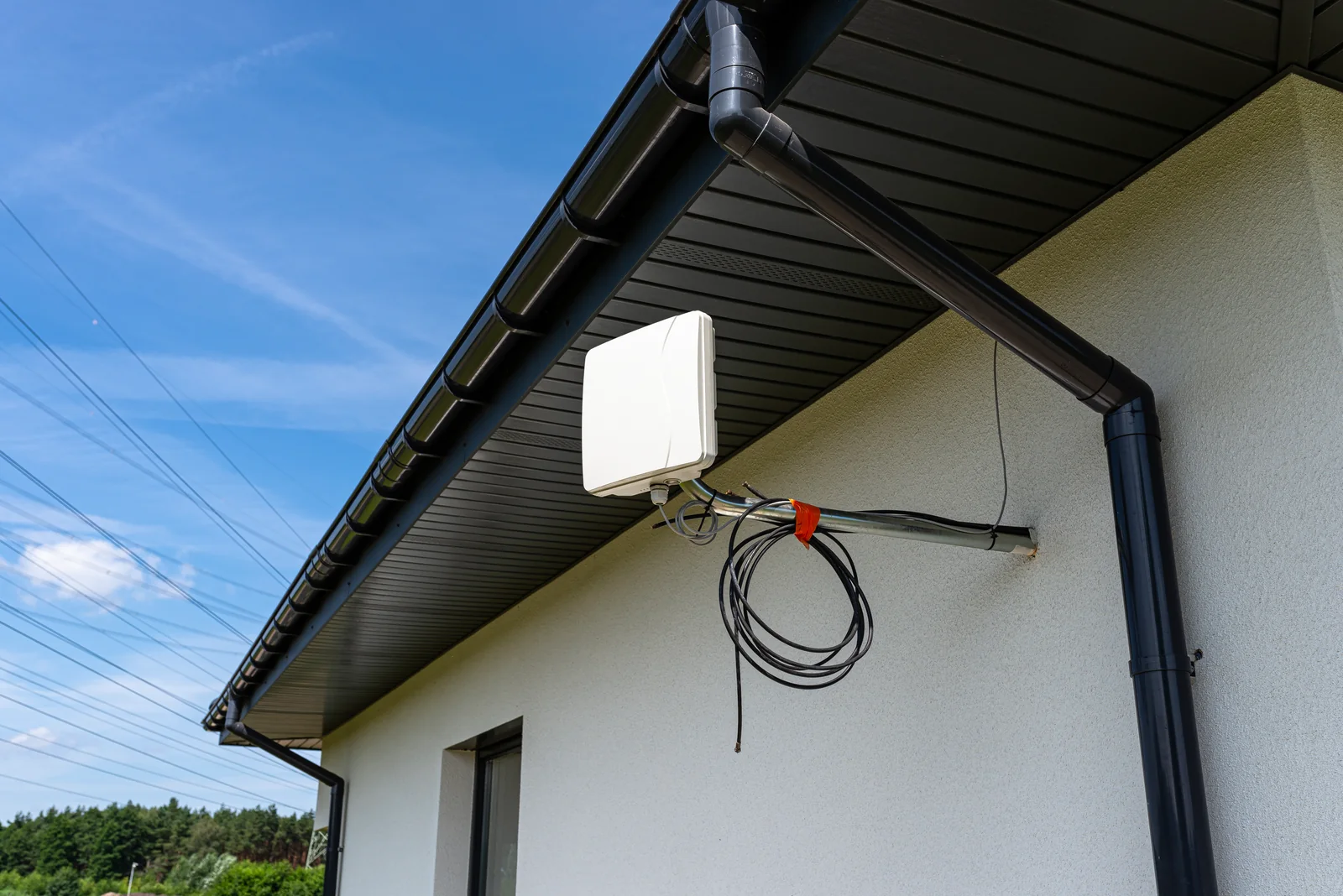
The outside antenna hears the towers; everything the booster does indoors starts with what reaches it.
How a Cell Phone Booster Works: Three Parts and a Cable
A cell phone signal booster is a relay for one building or one vehicle. It carries the signal your carrier already sends past whatever blocks it on the way in: metal roofing, thick masonry, coated window glass. A home kit has three working parts:
- Outside antenna: on the roof, a short mast or an exterior wall, listening for the nearest towers.
- Amplifier: an indoor box on wall power that raises the level of whatever the outside antenna hears.
- Inside antenna: in the room that needs coverage, rebroadcasting the stronger signal to nearby phones.
Coaxial cable connects the three, and every foot of it costs a little signal. When you call or upload, the chain works backward toward the tower. Car kits use the same layout, and most kits handle 4G LTE and a few lower-frequency 5G bands, though not every 5G band carriers use.
What the FCC Requires Before You Switch It On
The FCC's signal booster rule, 47 CFR 20.21, lets a customer in good standing run a consumer booster under their carrier's authorization. Its text, available through Cornell's Legal Information Institute, sets conditions that start before the first call:
- Get your carrier's consent before operation.
- Register the booster with that carrier, also before operation.
- Use only the antennas, cables and coupling devices the booster's manufacturer specifies.
- Never switch off the features designed to prevent interference with wireless networks.
Failing to comply, the rule says, "voids the authority to operate" the booster.
Registration is free: a carrier that consents to boosters must offer a free registration mechanism and collect at least the owner's name, the device's make and model, its serial number, where it sits and the date it first went into use. Copy the serial number before the amplifier disappears into an attic. Consent is voluntary, and the carrier may withdraw it.
Boosters marketed since March 1, 2014 must carry an FCC advisory, and on a consumer model its first instruction reads: "BEFORE USE, you MUST REGISTER THIS DEVICE with your wireless provider and have your provider's consent."
Who Should Do the Drilling?
Section 20.21 puts the consumer duties on the subscriber and names no installer for a home kit. Many kits are sold for owners to install; some include installation. Industrial signal boosters, a separate category in the same rule, carry a different warning: "This is NOT a CONSUMER device. It is designed for installation by FCC LICENSEES and QUALIFIED INSTALLERS."
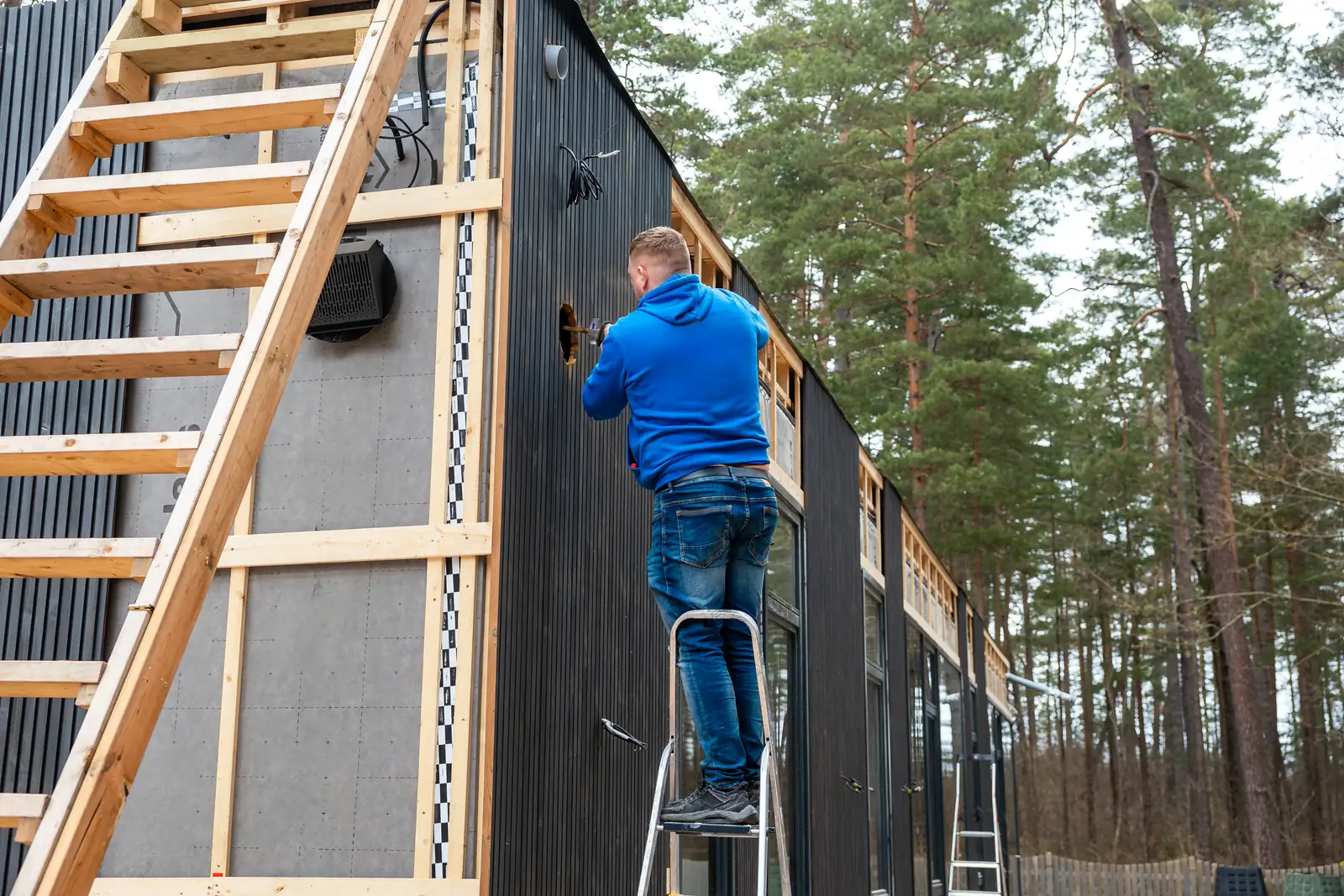
Mounting the outside antenna and bringing its cable indoors is the part of the job that changes the house.
A consumer kit is simpler on paper, not on the roof. A mast, a hole through siding and cable pulled across an attic make it a home improvement job. For jobs like that, the Federal Trade Commission's advice is to consider only contractors who hold a license and carry insurance. Which license, if any, a booster installer needs is a question for your state's licensing board; the FTC also points homeowners to their county. Among its warning signs is a contractor who wants you to pull the required building permits yourself.
|
Before the job
|
What to look for
|
|
License
|
A number you confirm yourself, through the state or county
|
|
Insurance
|
Proof of insurance, not a verbal promise
|
|
Contract
|
Written, listing the license number plus the installer's full contact details
|
|
Parts
|
Only antennas and cables the booster's maker specifies
|
|
Antenna spots
|
Both antennas kept 20 cm (8 inches) or more from people, per the label
|
|
Registration
|
Your carrier's consent and registration in place before the booster first runs
|
|
Permits
|
The installer, not you, pulls any permit the job requires
|
A first license check goes faster with a walkthrough open beside it. On legitpages.com, a site about one state's contractor license records, the home page lists a guide to reading a license record, lookup in eight steps included, and another on what the contract for a home improvement job has to spell out, from the down payment limit to the right to cancel.
A Booster Needs Some Signal to Work With
Does a cell phone booster work in a dead zone? Only if the dead zone stops at your walls. The amplifier strengthens what reaches the outside antenna, so the first test costs nothing: stand where that antenna would go and try a call.
Bars are a loose guide. For a number, open your phone's field test mode or signal status screen and read the strength in dBm. Readings closer to zero are stronger, and a stronger outside reading lets a booster cover a larger indoor area. Take readings around the house and at the highest spot you can reach safely, since that is where the outside antenna tends to end up.
If no usable signal reaches the outside of the house at all, a booster has nothing to work with. Wi-Fi calling over your home internet, or a carrier small cell that runs on broadband, is the better fit there.
Where the Antennas Go, and Why They Need Distance
The outside antenna goes where your readings were best, usually high on the roof or on the wall facing the towers. The inside antenna goes in the rooms where calls drop.
Distance between the two antennas matters more than most buyers expect. If the inside antenna's broadcast leaks back into the outside one, the booster amplifies its own output in a loop called oscillation. The FCC rule requires consumer boosters to detect and mitigate unintended oscillations, "such as may result from insufficient isolation between the antennas." They must also watch their own noise and gain, then correct themselves or switch off when they drift past those limits.
That protection keeps carrier networks clean, but it costs you coverage: a booster fighting feedback turns itself down. A floor or the roof deck between the antennas, more horizontal distance, and aiming them away from each other all add isolation.
The same advisory, printed on the device label, the packaging, the manual and online point-of-sale pages, adds a spacing rule: "Antennas MUST be installed at least 20 cm (8 inches) from any person." Keep the inside antenna off desks, headboards and couch backs; a ceiling or a high spot on the wall works better. And if the label also says the booster may be operated "ONLY in a fixed location for in-building use," it stays in the house and does not ride along in the car.
Frequently Asked Questions
Why are phone signal boosters illegal?
As a category, they aren't. The FCC rule lets a customer in good standing operate a consumer booster under the carrier's authorization, as long as its conditions are met, among them consent and registration before use, approved parts and protections left on. A booster run without them loses that authority. Guests are covered: the rule calls a visitor's incidental use of your booster "de minimis" and authorizes it under the visitor's own carrier. An operator also has to cooperate when the FCC or a carrier facing harmful interference asks, and shut the booster off if necessary. The rule also lets a consumer booster be certified only if it complies, and bars marketing a noncompliant one to anyone in the United States, except as other FCC marketing rules allow.
Does a booster change how 911 calls work?
It can. The consumer booster label carries this line: "WARNING. E911 location information may not be provided or may be inaccurate for calls served by using this device." If you dial 911 from a room the booster covers, give your address early in the call, and make sure everyone in the house knows to do the same.
Do you have to pay monthly for a cell phone booster?
The FCC rule speaks to one cost only: carriers that consent to boosters must give subscribers a free way to register them. The label text adds that most wireless providers consent, though some may not, so ask your carrier before you buy.
Can you install a cell phone booster yourself?
Often, yes: plenty of home kits are packaged for owner installation, and the FCC rule sets no installer requirement for a consumer booster. The hard parts are physical: getting the outside antenna high enough, keeping both antennas apart, and sealing the cable entry. If the job means climbing a roof or drilling through siding, the checks in the table above apply to whoever does it.


