Showing posts with label Wimax. Show all posts

Where Is 4G LTE Available in 2025?

T-Mobile 4G HSPA+ in 100 Markets in U.S.

Sprint / Clearwire 4G Wimax Network for 4G Phones & Data Cards

Verizon 4G LTE Cities in Yellow Dots 3G in Red 

MetroPCS LTE Map for Phones 

When 4G networks first emerged in the late 2000s and early 2010s, coverage was spotty and limited to select cities. At that time, maps showed patchy footprints for carriers like Verizon, Sprint, and T-Mobile, while many consumers wondered when their own neighborhoods would get faster speeds. Fast forward to 2025, and 4G LTE is everywhere — it has become the foundation of mobile connectivity around the world. Even though 5G is expanding rapidly, 4G remains critical for coverage, fallback, and reliability. This article explores the state of 4G coverage today, how to check availability, why LTE still matters, and what to expect in the future as mobile networks evolve.

How to Check 4G Coverage Today

Consumers now have access to several tools to determine whether 4G is available in their area. Carrier-provided maps remain the most common, but they often exaggerate or generalize availability. Independent crowdsourced tools have grown in popularity because they show real-world user experience instead of theoretical signal footprints. Crowdsourced coverage maps compile data from actual smartphone users running signal tests. These maps typically show 2G, 3G, 4G, and 5G layers side by side. Independent services also allow filtering by frequency band, technology, or carrier, which is particularly useful when trying to determine indoor reliability or rural signal strength. Government maps, such as those produced by regulatory agencies, display standardized coverage claims from carriers, although they may not capture local dead zones. Because of this, savvy consumers cross-check multiple sources before deciding on a carrier or mobile plan.

4G in the United States

Near-Universal Coverage

In the United States, 4G LTE has achieved near-universal penetration. The major carriers — Verizon, AT&T, and T-Mobile — all claim to cover more than 99% of the U.S. population with LTE. Smaller regional carriers and MVNOs piggyback on these networks, so LTE availability extends even to rural customers served indirectly.

Urban vs. Rural Divide

In dense cities, LTE service often overlaps with 5G, providing a seamless handoff when 5G coverage drops. In rural areas, LTE remains the most reliable option. Remote towns, highways, and agricultural zones often depend on lower-band LTE frequencies that provide broader coverage at the cost of speed.

Carrier Differences

Verizon has historically emphasized LTE reliability and still maintains strong coverage across both population centers and rural regions. AT&T has integrated LTE with its advanced voice network, making Voice over LTE a standard for most customers. T-Mobile aggressively markets 5G but continues to rely heavily on LTE as a backbone, especially in areas where its newer spectrum has yet to reach.

Global 4G Availability

4G LTE has become the global standard for mobile connectivity. In many parts of the world, especially developing regions, 4G leapfrogged older technologies and became the first widely available high-speed network. Europe maintains extensive LTE coverage, with many rural and coastal areas still depending primarily on 4G rather than 5G. In Asia, countries like South Korea, Japan, and China led early LTE adoption and now run dense networks, while rural Asia continues to rely on LTE even as 5G expands in metropolitan hubs. In Africa and Latin America, LTE is still the dominant mobile technology. While 5G launches are happening in select capitals, 4G provides the everyday connectivity backbone for the majority of subscribers. Globally, billions of devices still depend on LTE, and coverage maps in 2025 show it as the default layer of connectivity almost everywhere.

Why 4G Still Matters in 2025

Despite the hype around 5G, LTE remains essential for several reasons. First, it provides fallback coverage. Phones constantly switch between 5G and LTE depending on signal strength. When 5G drops or becomes overloaded, LTE picks up the slack. Second, it powers voice and messaging. Voice over LTE is now the default method for phone calls, and even in 5G zones, your calls often rely on LTE networks. Text messaging services also continue to run through LTE for redundancy. Third, LTE ensures device compatibility. Not all phones, especially budget or older models, support 5G. For millions of users worldwide, LTE is the highest-speed technology their devices can access. Fourth, LTE provides stronger indoor penetration. It operates on lower frequencies that travel farther and penetrate walls better than many high-band 5G frequencies, making LTE more reliable inside homes, schools, and office buildings. Finally, LTE is more resilient in rural and harsh environments. In remote areas, LTE remains more stable and efficient, covering mountainous regions, highways, and farming areas with greater reliability than 5G.

Real-World Limitations of 4G

While LTE is widespread, coverage still has limitations. Dead zones persist in valleys, basements, and shielded indoor spaces that block signal. These small pockets frustrate users even in otherwise well-covered cities. Congestion is another issue. During peak hours or at crowded events, LTE speeds can slow dramatically as networks reach capacity. Weather interference can also affect performance, particularly in areas relying on higher-frequency bands. Finally, coverage maps themselves can be misleading. They may show an area as covered, but real-world speeds may not be usable in practice.

The Future of 4G

LTE will not disappear soon. Just as 3G networks persisted long after 4G arrived, LTE will remain for many years to come. Carriers continue to invest in LTE upgrades such as carrier aggregation, LTE-Advanced Pro, and improved backhaul. For at least the next decade, LTE will operate alongside 5G. Phones and IoT devices will move seamlessly between both networks, and many industries including agriculture, shipping, and emergency services will continue to rely heavily on LTE for its proven reliability. At the same time, older networks are being phased out. With 3G now gone, LTE has become the baseline layer, guaranteeing coverage while newer standards build on top. Looking further ahead, LTE will also serve as a bridge to 6G. While 6G is still on the horizon, LTE ensures backward compatibility for billions of devices. Even as experimental 6G systems emerge later this decade, LTE will remain the fallback safety net for global connectivity.

Consumer Tips for Checking LTE

Consumers can take practical steps to ensure they get the most from LTE. Test your own signal instead of relying only on maps by running speed and signal checks on your device. Compare indoor and outdoor performance, since coverage often differs dramatically. Check whether your phone supports the full range of LTE bands offered by your carrier. Devices with broader band support usually perform better. If you are planning a road trip, camping excursion, or travel abroad, research LTE coverage ahead of time, particularly in rural zones where fallback connectivity may be critical.

Conclusion

4G LTE is no longer the cutting edge of mobile technology, but it is still the backbone of wireless connectivity in 2025. From dense cities to remote highways, LTE ensures that billions of people remain connected when 5G cannot. It delivers dependable voice calls, solid internet browsing, and a crucial safety net in emergencies. While the future is moving toward faster 5G and eventually 6G networks, LTE will remain the quiet workhorse of mobile communications for many years. For consumers, that means reliable service, strong fallback coverage, and a reminder that the maps showing LTE availability may be the most important ones to check before switching carriers or traveling.

What Does G Stand for in 4G? Explained Simply

2g, 3g, 4g chart
4G = 4th Generation Data Network

What Does G Stand For in 4G?

The world of mobile technology is full of abbreviations that can feel confusing at first. One of the most common is the “G” you see in terms like 2G, 3G, 4G, and now 5G. But what does the “G” actually stand for? The answer is simple: G stands for “Generation.”

The Meaning of “G”

When we talk about 4G, we’re really saying “Fourth Generation.” Each generation of wireless technology represents a leap forward in speed, reliability, and capabilities. The progression from one G to the next shows how the industry has evolved to keep up with user demand for faster data and more connected devices.

  • 1G – The first generation of mobile networks, launched in the 1980s, was analog and only supported voice calls.

  • 2G – Introduced in the 1990s, 2G was digital and added SMS (text messaging) and limited data.

  • 3G – In the early 2000s, 3G networks brought faster data speeds, making mobile internet browsing and app use possible.

  • 4G – Rolled out widely in the 2010s, 4G (especially LTE, or Long-Term Evolution) enabled high-speed internet, video streaming, and smooth app performance on smartphones.

  • 5G – The latest generation, now expanding worldwide, promises ultra-low latency and speeds up to 100 times faster than 4G.

Why 4G Was a Game-Changer

While 5G is the new buzzword, 4G has been the backbone of mobile communication for more than a decade. It was the first network generation fast enough to reliably support:

  • Streaming video in HD without constant buffering

  • Mobile gaming with responsive performance

  • Navigation apps like Google Maps or Waze with real-time updates

  • Social media apps that rely heavily on video and photo sharing

4G allowed smartphones to become truly “smart,” giving users access to powerful apps, cloud storage, and connected services without the constant frustration of dead zones or lag.

What About Dead Zones on 4G?

Even with 4G’s massive improvements, dead zones still exist. These are areas where coverage is weak or nonexistent, such as rural communities, mountains, or even parts of cities with heavy building interference. Mobile carriers build towers and expand coverage, but gaps remain.

For example:

  • Rural areas often have fewer towers, making 4G signals inconsistent.

  • Underground locations like subway systems can create dead zones unless special repeaters are installed.

  • Crowded events like stadiums can overload networks, temporarily making 4G feel unusable.

DeadZones.com exists to help people map and report these areas, so you can avoid frustration and choose the best carrier for your location.

The Future Beyond 4G

As 5G continues to expand, it promises to fill many of the coverage gaps left by 4G. However, because 5G uses higher-frequency signals that don’t travel as far, it also needs more antennas and infrastructure to work well. That means dead zones will continue to exist in some form, making crowd-sourced coverage maps more important than ever.

Final Thoughts

So, the “G” in 4G simply means “Generation.” But each G represents much more than a number—it reflects a massive leap in mobile communication technology. 4G made streaming, apps, and cloud-based services a part of daily life, and even though 5G is here, 4G will remain critical for years to come.

If you’ve ever wondered why your phone drops to “3G” in certain areas or struggles with no signal at all, you’re not alone. That’s where mapping dead zones becomes essential to improving connectivity and holding carriers accountable.   what does 2G, 3G, 4G mean?

Sprint Service Plans and Coverage Review

Sprint Dead Zones USA MapCoverage: Sprint, which is now part of T-Mobile, was a major wireless service provider in the United States. While the Sprint brand has been phased out, customers are now under the T-Mobile network and plans. Here is a review of T-Mobile's service plans and coverage, which now encompass former Sprint customers:

Plans: T-Mobile offers a range of postpaid and prepaid plans to suit different needs. These plans typically include unlimited talk, text, and data, with varying data speeds and data allowances. Customers can choose from different plan options based on their usage requirements and budget.

Coverage: T-Mobile's network coverage has expanded significantly after the merger with Sprint. They provide nationwide coverage across the United States, with improved coverage in rural areas and expanded 5G coverage in select cities. T-Mobile utilizes a combination of low-band, mid-band, and high-band spectrum to offer wide coverage and fast data speeds.

Unlimited Plans: T-Mobile offers several unlimited plans that provide unlimited talk, text, and data usage. These plans may have different data deprioritization thresholds, meaning that after a certain threshold of data usage, speeds may be temporarily reduced during times of network congestion.

Family Plans: T-Mobile provides family plans that allow multiple lines to share a data pool. This can be a cost-effective option for families or groups with multiple lines.

5G Network: T-Mobile has invested in the deployment of 5G technology and offers 5G coverage in various areas. Their 5G network encompasses both sub-6 GHz and mmWave frequencies, providing improved speed and capacity in supported locations.

Device Selection: T-Mobile offers a wide selection of smartphones and other devices for purchase. Customers can choose from flagship devices, mid-range options, and budget-friendly devices. They also support Bring Your Own Device (BYOD) programs, allowing customers to use their own compatible devices on the network.

Customer Service: T-Mobile has customer service channels available, including phone support, online chat, and in-store assistance at T-Mobile retail locations.

It's important to note that the information provided reflects the combined offerings of T-Mobile and Sprint following their merger. It's recommended to visit T-Mobile's official website or contact their customer service for the most up-to-date information on their current plans, pricing, and coverage in your specific area.

Finding the best cell phone coverage just got easier by comparing cell phone coverage reports from other customers. Which wireless carrier has the worst cell phone coverage?
Other Reviews: 
Feedback is always welcome. Please submit your comments below.

@SprintCare Twitter Chatter

Can You Trust Your Carrier To Measure Your Data Usage?


Overage charges for data usage is one of the biggest new wireless industry scams that is starting to develop.  How can carriers charge consumers for data usage when consumers have no context to understand how much data they are actually using?  What regulatory parameters have the FCC and FTC done to manage the developing crises?  How can you trust the carriers themselves to self regulate their own customer data usage?  Who or what independent application is measuring the amount of data you are using on the phone?  How can carriers charge you the ridiculous overage fees similar to what they have done in the past for text messaging?  Text messaging is a scam and its a $10 billion dollar business for both Verizon and AT&T.  Data usage will probably be a $100B dollar business without any fair competition.  

Which Carrier Has The Fastest 3G & 4G Network?


T-Mobile USA HSPA+ and the AT&T LTE networks are the nation's fastest "3G" and "4G" networks, respectively, among Tier 1 U.S. carriers, according to a new study from PCWorld.  AT&T, T-Mobile top network speed tests.

PC World conducted tests on the networks of the four Tier 1 carriers in 13 cities: Atlanta, Boston, Chicago, Dallas, Denver, Las Vegas, Los Angeles, New Orleans, New York, San Francisco, San Jose, Seattle and Washington, D.C. The tests were conducted by Novarum, a strategic wireless consulting firm, and used smartphones suggested by the carriers.

Among "3G" networks, T-Mobile's HSPA+ network performed the best, with average downlink speeds of 3.84 Mbps. AT&T's HSPA+21 network came in second, with average downlink speeds of 2.62 Mbps. Verizon came in third with average speeds of 1.05 Mbps and Sprint came in fourth, with average speeds of 0.59 Mbps.

AT&T's LTE network provided the best downlink speeds among 4G networks, topping out at an average of 9.56 Mbps. That bested Verizon Wireless' (NYSE:VZ) LTE network, which had average downlink speeds of 7.35 Mbps. However, Verizon's LTE network beat AT&T's in uplink speeds, with an average uplink speed of 5.85 Mbps compared with AT&T's 5.15 Mbps.

4G vs LTE Marketing Confusion

Let's face it the AT&T, Verizon, Sprint & T-Mobile, and the rest of the wireless carriers have enough money to convince most naive consumers to think whatever they want you to think.  Over that last decade, carriers have spent billions of dollars trying to differentiate their speeds and new phones.  But at the end of the day, the consumer does not care if their phone uses Wimax, 4G, HSPA+, or LTE.  They just want a reliable connection that is can access data speeds quickly.  Unfortunately, the carriers drink too much of their own Cool-Aid and marketing becomes a self-fulfilling prophecy of listening to your own BS. 

Here is a case in point based on the survey completed by IDC:  3G was a clever marketing term to convey faster speeds on phones and the industry spent billions of dollars promoting it. 85% of people understand it because they remember what 3G is. Remember the 3G Super Bowl commercials just a few years ago?  You would think that the industry would simply wrap their arms around the 4G marketing concept and run with that for a few years and save themselves some customer service headaches of explaining something new.

No, instead the industry has adopted a new technology called LTE which is mobile broadband.  LTE works as mobile broadband for your home network and also on some phones eventually.  Is it necessary for carriers to spend billions more educating consumers that they have LTE when they could have simply just called it 4G?  Someone in a marketing department at Verizon will eventually get fired over this if they don't figure it out soon.

Carriers Releasing WiFi Security Propaganda to Promote 4G


4G Wireless Propaganda is a PR strategy aimed at influencing the attitude of consumers towards believing the accessing data over WiFi is not secure and 4G is.  The carriers have to start releasing articles like his one "Amazon cloud can help hack WiFi networks - expert" to promote fear into the minds of wireless consumers.  Carriers are not presenting the facts about WiFi because it would be a disservice to their business models which are essentially competing with free.   Carriers are hoping to change the groundswell of WiFi users in order to influence the industry towards their expensive and often inferiors solutions for data connectivity.  WiFi vs 4G is now in the early stages of political warfare and I hope that all geeks understand this and read every "fear" article with a grain of salt.

We attending CES this week and 4G is now starting to get heavily promoted to consumers but I am not seeing a groundswell of people that are convinced their pricing models are going to hold up.  I am a bit of a contrarian which it comes to 4G being the next product for carriers to boost their margins and expand their customer base.  Does 4G have any credibility when 3G still sucks?  Here is an article on the 4G BS and some other posts that will help you understand our position on the topic of 4G vs Free WiFi and carriers promote LTE by discounting the reliability of WiFi.

What Does LTE Stand For?

LTE = Long Term Evolution
Long Term Evolution (LTE).  It is a new radio platform technology that will allow carriers to give you higher wireless upload and download speeds currently between 5-12 mbps but expected to increase. Verizon Wireless,  AT&T & MetroPCS in the United States and several worldwide LTE carriers began rolling out the new network in 2009.  The world's first publicly available LTE service was opened by TeliaSonera in the two Scandinavia in December of 2009.

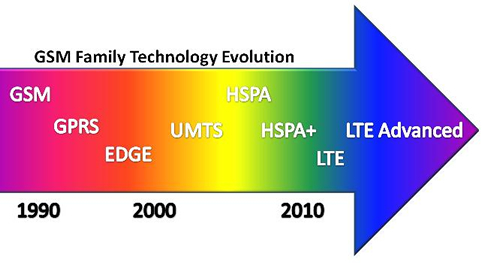
LTE and is part of the GSM evolutionary path beyond 3G technology, following EDGE, UMTS, HSPA (HSDPA and HSUPA combined) and HSPA Evolution (HSPA+). LTE is a set of enhancements to the Universal Mobile Telecommunications System (UMTS) which was introduced in 3rd Generation Partnership Project (3GPP) Release 8.  HSPA Evolution is a stepping-stone of speeds to LTE for many carriers that will be rolled out slowly. Carriers began working on LTE in 2004 3GPP and the initial deployment of LTE is targeted for 2010 and 2011. The objective of LTE is to provide a high-performance radio access that offers good signal coverage in vehicles that are moving and that can coexist with HSPA and earlier networks. Carriers can scale bandwidth to migrate their networks and users from HSPA to LTE over time in areas that need it most.

Related Articles:
List of Verizon Wireless 4G LTE Cities
How Does 4G & LTE Compete with Free?
LTE Cell Phone Tower Industry Growth
How Each Carrier Defines 4G
3G & 4G Coverage Parity by 2013
Will AT&T's New Faster HSPA+ Data Network Result in Fewer Dropped Calls?
Wireless Network Armageddon in 2012
Who Has the Best 4G Coverage?

How Each Carrier Defines 4G


4G is as confusing as ever to the average consumer.  Verizon and MetroPCS are launching their 4G LTE network and three out of the four major US carrier Verizon, Sprint, and T-Mobile promote the fastest 4G data networks.  However, each company defines 4G differently and none of them meet International Telecommunication Union standards. The ITU defines 4G as a connection capable of 100 mbps to 1 gbps. The cellular data network's 4G speeds don't even come close to this and the only marketing thing each carrier seems to agree upon is that 4G is just what comes after 3G. While the title of 4G isn't accurate by International Standards is meaningless the carriers now have created a new step of planned obsolescence.  Here is an article from Life Hacker which will try to simply each offering.  Read More.

Verizon 4G LTE Will Not Work on Macs

Verizon LTE is only for PCs and NOT Macs
Sadly Apple Macs will not be able to use the new Verizon 4G LTE network anytime soon.  Devices available are currently built for PCs and require purchasing a $100 LG and Pantech 4G LTE modem.  Verizon’s LTE USB modem devices will only compatible with Windows XP, Vista or Windows 7.  See the latest 4G LTE Verizon data plans but we wonder how many people will be willing to spend $600-$1000 per year for 5-12 mbps.

Verizon, T-Mobile, Sprint, MetroPCS 4G Pricing Compared

4G is getting a bit out of hand with regards to misleading 4G marketing claims and speeds.  Sprint is using Wimax, T-Mobile & AT&T are using HSPA+, Verizon and MetroPCS are both using LTE.  AT&T is not charted above because they refuse to say how fast their network will be.  Here is another chart comparing 4G & 3G network speeds.  Every carrier but T-Mobile seems to have data pricing wrong and don't realize that their customers are increasingly using Wifi for data offload and this is free.

Clearwire Hidden Data Cap & Early Termination Fees Class Action Investigation

Clearwire Corporation (NASDAQ: CLWR) Misleading Advertising Investigation

Does your wireless internet service seem slower than it should be? Do you have difficulty streaming movies or downloading large files pm up data card or Clearwire device?  Are you not getting coverage where you were promised?

Milberg LLP is investigating Clearwire Corporation, a provider of wireless internet services. Clearwire promises consumers “unlimited, high speed” internet. Milberg is investigating the possibility that contrary to these promises, Clearwire imposes a hidden “cap” on usage and once users exceed that cap, Clearwire deliberately slows their internet speeds, depriving users of the high-speed internet access for which they paid. Making matters worse, Clearwire imposes an early termination fee, so users who have been “capped” cannot cancel their service without paying an additional fee. If you believe that your internet speed has been reduced by Clearwire and you wish to talk to a lawyer from Milberg LLP about this, at no obligation to you, please complete the form.

Milberg LLP has been representing consumers and investors for more than four decades and serves as lead counsel in federal and state courts throughout the United States. Please visit the Milberg website for more information about the firm. If you wish to discuss this matter with us or have any questions concerning your rights and interests with regard to this matter, please contact the following attorney:

Google TV Will Disrupt the Cable Distribution Monopoly

It's great to see networks like Fox starting to pull their programming from Google TV.  This only means one thing!  Networks who believe in programming and cable companies who believe in paid distribution feel threatened.   Google TV is a disruptive technology platform that seeks to destroy a monopolistic distribution model of content and companies like Comcast denies Google TV as a competitor. The cable distribution monopoly and give consumers what they want.  Programming is about to become a thing of the past as more and more consumers just consume what they want when they want.  Not only do they select their programming on-demand but they are not doing it on multiple devices like the iPhone, iPad and Android.  Cable operators have leverage because they are in the broadband access business and starting to get into the wireless broadband access business.  The only thing I think that will begin to protect their business in the short term is to emphasize 3D TV channels which provide a tremendously cool viewing experience (only at night). 

For the longest time cable companies like Comcast, Cablevision, Cox, Time Warner have made most of their money charging networks carriage rights.  The FCC knows consumers are getting screwed and has not disrupted this shady business practice and networks have been getting away with it making money hand over fist.   Well, this is all about to change if you can now consumer your programming directly over the internet.  You don't need a cable line any longer when you can download the programming over your neighbors shared WiFi network or your wireless carrier 4G, LTE or Wimax network.   The chart below shows you how the cable companies are losing leverage for the distribution of their content.  They used to own almost 50% of the channels and now they own only 15% as the number of channels have increased and the content has become more specialized.  Great examples of this include the NBA, NFL and MLB who have started their own networks and don't rely on CBS, ABC, NBC and Fox for all of their content distribution. 

Wireless Network Armageddon in 2012


The analysis compiled three notable studies on mobile data traffic growth from Cisco Systems, Coda Research, and the Yankee Group. The average of these three studies estimates mobile data traffic to grow 5x between 2009-2011, 20x between 2009-2013, and 35x between 2009-2014. FCC Chairman Julius Genachowski indicated that these studies were done before the iPad/tablet boom and therefore the growth may actually be understated. Our study shows that cell site growth is 7% while decelerating and Wi-Fi growth is accelerating to around 40%. in the U.S.

There is obviously going to be a spectrum deficit and the pain that consumers are feeling is going to get even worse. Some solutions trying to tackle the problem include hardware at each cell site to optimize the radio networks, offloading data to Wi-Fi and femtocells. Media optimization and compression will likely be used as well and might be more cost-effective.  However, ultimately there will be 10-20 times more Wi-Fi networks and soon there will be more organic Wi-Fi management companies like Boingo, Fon & Google Wifi (TBD) to help users access the almost free networks.

Free WiFi Hotspots Growing 5X Faster than Cell Towers

There are 72,000+ US hotspots growing at an average rate of 40% per year.  Theses hotspots are located at restaurants, train stations, airports, military bases, libraries, hotels, hospitals, coffee shops, bookstores, fuel stations, department stores, supermarkets, RV parks and campgrounds, public pay phones, and other public places. Many universities and schools have wireless networks in their campus.  Below is a list of 80,859 US cell phone towers growing at around 8% per year and the 14 companies that manage them.  One major US carrier Verizon is not included on the list because they are not actively pursuing co-location opportunities.

Rank - Towers - Company - Stock Symbol / Owner
1 - 22,321 - CrownCastle.com - $CCI
2 - 20,594 - Americantower.com - $AMT
3 - 10,792 - Att.com/towers - $T
4 - 8,588 - Sbasite.com - $SBAC
5 - 7,000 - T-mobiletowers.com -
6 - 3,700 - Gtpsites.com - Macquire Group
7 - 3,058 - Mobilitie.com
8 - 3,000 - Towerco.com
9 - 489 - Pegasustower.com
10 - 350 - Insitewireless.com
11 - 310 - Diamondcomm.com
12 - 305 - Subcarrier.com
13 - 250 - Horvathcommunications.com
14 - 102 - Tarpontowers.com


How to Get a Free Sprint 3G Femtocell

Sprint Airave 3G EV-DO Femtocell

Sprint will apparently begin offering FREE femtocells for its "qualified customers" that have reception problems on their 3G / EV-DO phones. Sprint's new Airave femtocell now supports 3G which technically should be 3X faster (500-700 kbps kilobytes per second ) than their 2G Samsung femtocell of 150 (kbps).  The updated Airave Access Point (aka what is a femtocell?) uses a customer's broadband internet connection to route calls back to the Sprint network and is being marketed by Sprint as a mini cell tower. It covers up to 5,000 square feet and supports up to six calls simultaneously.  The Airave will be available in stores to customers with specific in-building reception issues.

Sprint 2G Airave femtocell has been around for almost 3 years since 2007 and sells for $100.  For some reason that makes no business sense, Sprint will still continue to offering its' 2G data version of Airave for $99.99, plus a required $4.99/month plus an activation fee of $10 for a single line or $20 multi-line plans.  We don't have a clue why they would continue charging for a old product other than possibly trying to avoid cannibalizing their existing customers.

Sprint is riding the data wave that AT&T creating launched their AT&T femtocell earlier this year.  Sprint seems to be doing it right and offering the device for free which is how it should be.  We are not quite sure what criteria will get you the "qualified customer" status yet but here are some ideas below that might help get you a free femtocell:
  1. Find out if the Sprint 3G femtocell is available in your market.
  2. Use Sprint Dead Zones Map map to share reception problems in your neighborhood (see map below)
  3. Complain a lot to Sprint customer service that your home reception is poor
  4. Document your dropped calls on a daily basis using your monthly bill
  5. Show Sprint that you have been a customer for many years
  6. Show Sprint that you have multiple Sprint phones in the house
  7. Show Sprint that you have multiple subscribers in the house
  8. Show Sprint that you are a Clearwire customer
  9. Become friendly with your local Sprint store sales manager
  10. Find out when your contract expires and use renewal as leverage
If you know of any other factors that could help influence Sprint to give you a free femtocell please submit in the comments below or email us. See our map below to build your case to the carrier and use the map to show problems in your area.


10 Reasons Why Skype Will Make You Rich


Skype's IPO could be one of the hottest new technology stocks to hit Wall Street since Google's IPO at $100 per share in 2004.  If Skype (now the largest wireless carrier in the world) does in fact do a silent auction IPO (similar to Google's IPO process) and only sells a small portion of the company (< 25%)  I think the stock will fly higher.  Owning shares of the Skype IPO could make you rich and dumping your wireless carrier could save you even more money and make your richer.   Here are 10 reasons why this could be one of the most exciting and disruptive companies to big telecom over the next decade.  The day of reckoning may soon be here . . .


#1 - Making quality 3G phone calls over AT&T, Verizon, Sprint & T-Mobile is impossible.  It is a rarity these days when my call doesn't drop in the first few seconds or on a call.  The carrier networks are just horrible and do not work and the problem is only getting worse.

#2 - If you have ever used Skype to make international phone calls you know just how special and unique the service is.  The voice and video quality is tremendous.  I am always perplexed why the same video quality experience can't be achieved when make Skype calls inside the US.  I say it's big telecom technical shenanigans screwing with VoIP packets across the network.

#3 - The service is currently FREE for Skype to Skype calls.  As soon as this company is public the shareholders will likely demand more profits and demand the company expand its advertising capabilities for its free users.  Personally, I don't really care because Google did the same thing and I think their search advertising is highly relevant.

#4 - Making Skype to any phone line is dirt cheap and will likely soon be free as well as soon as their advertising CPMs are high enough to pull the 2 cents per minute rates.

#5 - Skype will soon be the largest carrier in the world with over 500+ million active users and they have 13% of the International call market share according to The Inquisitr.  China Mobile is #2 with 527 million users, #17 Verizon 92M, #17 AT&T 87M, Sprint 48M, T-Mobile USA 33M.

#6 - Skype's annual revenue will near $1B next year even though only 6% of their customers are paying for minutes according to Tech Crunch.  Skype is wildly underpricing the value of their service and yet most consumers continue to pay their wireless carrier $50 per month or $600 per year.

#7 - US wireless carriers are still hawking prepaid data plans where minutes expire.  This is a complete scam and will likely be disrupted in the coming years as consumers and businesses get smart.  Pay as you go and advertising-based plans could save most users thousands of dollars per year.

#8 - Every smartphone will soon have a front-end video camera and some time of Skype or Google Voice software client on the phone eventually.   With Google Voice gaining steam this will only continue to educate consumers that VoIP phone calls over Wifi is the only way to make calls.

#9 - US wireless carriers are investing billions of dollars to build out 4G, LTE, WiMAX networks when more like more than 50%+ of phone calls are made indoors.   Wifi is still the best solution to connect through Skype to VoIP and likely will be for years to come.  Why do you need an expensive voice service?

#10 - Have you ever tried shopping for a phone in Europe or Asia?  Well, guess what you get to pick the wireless service FIRST and then the carrier.  Sounds backward doesn't it having to chose the iPhone being locked into AT&T.  Consumers are tired of cell phones being tied to specific carriers and want a standard platform where all phones work on all carriers. No more contracts and horrible wireless service carriers who's only value is lining the pocketbooks of shareholders with huge dividends.  Skype's service and Android operating system may soon have the power, scale and leverage to make this happen throughout the world with a Skype Phone.

What Does 1G 2G 2.5G 3G 3.5G 4G 5G Mean?


With the announcement of the new iPhone 4 there is a lot of confusion about what is 3G and 4G.  Here is a great video which explains the evolution of the technology and what AT&T, Verizon, T-Mobile and Sprint use on their networks.  The first iPhone 3G used a technology called EGDE and the new iPhone 4 is using the the HSPA technology.  Here are the protocols explained so that when someone says they have a 4G iPhone you can correct them.

Generation - Definition - Technologies - Speeds
1G - Original analog cellular for voice (AMPS, NMT, TACS) 14.4 kbps
2G - Digital narrowband circuit data  (TDMA, CDMA) 9-14.4 kbps
2.5G - Packet data onto a 2G network (GPRS, EDGE) 20-40 kpbs
3G - Digital broadband packet data (CDMA, EV-DO, UMTS, EDGE) 500-700 kbps
3.5G - Replacement for EDGE is (HSPA) 1-3 mbps
4G - Digital broadband packet data all IP (Wi-Fi, WIMAX, LTE) 3-5 mbps
5G - Gigabit per second in a few years (?) 1+ gbps

3G & 4G Coverage Parity by 2013

According to industry experts, 4G wireless network coverage will reach parity with its 3G networks in 2013.  Parity is referring to when the size of a wireless footprint to match 3Gs current footprint which is about 98% of the population. Some say that 4G could reach 100 million people this year but that seems optimistic.  This is expected to increase to 200 million by the end of 2012.

Our speculation is that the industry will try and confuse the consumer as much as possible in order to try and differentiate their services.  Sprint uses the term WIMAX, Verizon is going with LTE and who knows what AT&T is going to market.  What all consumers need to know is that Wi-Fi is most definitely a competitor and its free.  Be a smart consumer and recognize that you may not need data access at high speeds on all parts of the globe so having a huge footprint is not that necessary.  3G was a big step-up from 2G and consumers really noticed the difference.  However, will they be able to differentiate 4G from Wifi?  I say No!

My speculation is that speed and coverage standards will need to be set in the next few years because the marketing coverage wars are only going to get more intense.  Clearwire is still a small company in terms of market share yet they already have a large Wimax (4G) footprint.  I am surprised that they haven't partnered with more carriers like T-Mobile, AT&T and Verizon who plan on building out their own networks or sticking with Wifi in certain areas.  Cable companies like Comcast and Sprint seem the most aggressive about leveraging the huge investment Clearwire has already made.

Related stories
Clearwire Adds "Honest" Coverage Maps
Rural Wireless Carriers Have Better Coverage
Forget 4G Cell Towers, Bring on Femtocells
Femtocells & Wifi - Can't They Just Get Along?

Weak Home Cell Phone Signals

1. Rural areas
In many rural areas, the housing density is too low to make the construction of a new base station commercially viable. In these cases it is unlikely that the service provider will do anything to improve reception, due to the high cost of erecting a new tower. As a result, the only way to obtain strong cell phone signal in these areas is usually to install a home cellular repeater. In flat rural areas the signal is unlikely to suffer from multipath interference, so will just be heavily attenuated by the distance. In these cases the installation of a cellular repeater will generally massively increase signal strength just due to the amplifier, even a great distance from the broadcast towers.
2. Building construction material

Some construction materials very rapidly attenuate cell phone signal strength. Older buildings, such as churches, which use lead in their roofing material will very effectively block any signal. Any building which has a significant thickness of concrete or amount of metal used in its production will attenuate the signal. Concrete floors are often poured onto a metal pan which completely blocks most radio signals. Some solid foam insulation and some fiberglass insulation used in roofs or exterior walls has foil backing, which can reduce transmittance. Energy-efficient windows and metal window screens are also very effective at blocking radio signals. Some materials have peaks in their absorption spectra which massively decrease signal strength.
3. Building size
Large buildings, such as warehouses, hospitals and factories, often have no cellular reception further than a few meters from the outside wall. Low signal strength is also often the case in underground areas such as basements and in shops and restaurants located towards the centre of shopping malls. This is caused by both the fact that the signal is attenuated heavily as it enters the building and the interference as the signal is reflected by the objects inside the building. For this reason in these cases an external antenna is usually desirable.
4. Multipath interference

Even in urban areas which usually have strong cellular signals throughout, there are often dead zones caused by destructive interference of waves which have taken different paths (caused by the signal bouncing off buildings etc.). These usually have an area of a few blocks and will usually only affect one of the two frequency ranges used by cell phones. This is because the different wavelengths of the different frequencies interfere destructively at different points. Directional antennas are very helpful at overcoming this since they can be placed at points of constructive interference and aligned so as not to receive the destructive signal.
5. Diffraction and general attenuation

The longer wavelengths have the advantage of being able to diffract to a greater degree so are less reliant on line of sight to obtain a good signal, but still attenuate significantly. Because the frequencies which cell phones use are too high to reflect off the ionosphere as shortwave radio waves do, cell phone waves cannot travel via the ionosphere.

Popular Posts